Advertising on Facebook: The Difference between Boosted Posts and Facebook Ads
Try Thryv for FreeBy Stephanie Love, Small Business Expert
Updated October 20, 2026 · 14 min read
I have a confession to make. Taco Tuesday comes twice a week in our household. My husband and I have become devout regulars at a local taco shop, partly because of their killer queso, and partly because of their hyper-friendly staff. A couple of weeks ago, we visited our taco joint of choice and got into a conversation with the owner, who politely asked what I do for work. When I get this question from local business owners, I hesitate to mention our company right off the bat, as I don’t want to come off as salesy to the owners of my favorite local hot spots.
Our conversation quickly progressed into how his business has been affected by the larger Tex-Mex options in the surrounding area. He mentioned everything he was doing to get the attention of potential local customers, one of which was advertising on Facebook.
When I asked what types of ads he was running and how he was targeting them, he began talking about his posts, and how he was paying to boost them. “Huh,” I said. “So you’re boosting posts and creating advertising campaigns too…business should be booming!” **cricket chirps** …and there was the moment of disconnect. I realized that in his mind, boosting posts on Facebook is the same as advertising on Facebook. And he’s not alone in his thinking.
Market and Grow Your Business More Effectively With Thryv Marketing Center
Thryv Marketing Center helps you attract new customers to your business and shows you which marketing strategies work best for your customers so you don’t waste time and money on the wrong tactics.
Facebook advertising has evolved significantly in the past few years. Today, ads are managed through Meta Ads Manager and Meta Business Suite, where businesses can run campaigns across Facebook, Instagram, Messenger, and the Meta Audience Network from one place.
New automation tools such as Advantage+ targeting, AI-generated ad creative, and automatic placement optimization make it easier for small businesses to launch campaigns that reach the right audiences without needing advanced advertising expertise.
While the Boost Post button still exists, many businesses now combine boosted posts with more advanced campaigns inside Ads Manager to drive traffic, leads, bookings, and purchases.
A Common Misconception
Do you have a Business Page on Facebook? (You should.) If you do, you likely post regularly to your news feed so your followers can keep up with your business. Once you publish a post to your feed, Facebook offers you the option to boost it for additional visibility (in exchange for a little extra cash). Since boosting requires a monetary investment, many business owners stop there and assume they’ve covered their advertising bases on Facebook.
Not so! Boosting is just one way of getting targeted, added visibility with your local Facebook audience. But Facebook also offers targeted ad campaigns as an additional, more strategic method of getting your business’s name out there and creating new leads.
The Difference between Boosted Posts and Facebook Ads
Boosted Posts
Boosted Facebook posts are nothing more than typical posts you’ve previously created that are already live in your Facebook Business Page’s feed, which you pay to promote to a larger audience than you’re currently reaching.
A boosted post is still the simplest way to turn an existing Facebook post into a paid promotion. When you click Boost Post, Facebook shows that content to a larger audience beyond your followers.
Today, boosted posts can appear not only in the Facebook news feed but also across Instagram feeds, Stories, and other Meta placements, depending on the automatic placement settings Meta selects.
Boosting works best when you already have a post performing well organically. By amplifying content that people are already engaging with, businesses can quickly increase visibility, comments, and shares.
Common modern uses for boosted posts include:
- Promoting local events or limited-time promotions
- Increasing engagement on helpful or educational content
- Expanding the reach of announcements or product launches
- Promoting posts that already have strong engagement
Facebook Ads
A more advanced way to advertise on Facebook, ads target a very specific demographic of potential customers and help you attach calls to action to achieve various goals. They offer in-depth analytics and reporting on the ads you run, so you can track engagement.
(Somewhere in the Middle) Boosted Post Ads
Within Facebook’s ad console, there’s an option to create what they call a boosted post ad. Positioned somewhere in between the two previously mentioned advertising methods, this approach gives you a choice of whether or not the post/ad-combo will appear on your business page or not. Unlike simpler boosted posts, you get the advanced targeting benefits of Facebook ads. But unlike Facebook ads, you lack the opportunity to add the ever-important call-to-action button.
The Time and Place for Each
Now that we know the difference between boosted posts and Facebook ads, let’s talk about when to use each. Each method of paying to promote your business via Facebook has its benefits.
Boosted Posts
Boosting works best when you’re trying to drive brand recognition and audience engagement, such as likes, shares, comments, and visits to your Facebook Business Page. To boost a post, choose one of your higher-performing, more engaging posts and click the Boost Post button in the bottom right-hand corner. Facebook will walk you through the rest.
Pro tip: Avoid boosting posts that contain content you’re sharing from an outside source. If you were to do this, you’d basically be paying to promote someone else’s brand. Stick with your own content so you remain the star.
When Boosting a Post Makes Sense
Boosted posts are ideal for quick visibility and engagement, especially when you want to reach more people quickly without setting up a full campaign.
Boosting typically focuses on simple goals such as:
- Increasing post engagement (likes, comments, shares)
- Driving traffic to a website
- Encouraging messages from potential customers
However, boosted posts have simpler targeting and optimization options compared to full ad campaigns. They usually focus on broader demographics like age, interests, and location rather than advanced audience segmentation.
Because of this, boosted posts work best for top-of-funnel visibility rather than lead generation or sales campaigns.
Facebook Ads
Targeted ad campaigns work best to drive actual business results. And these days, they also offer a host of upscaled formatting options outside of the additional analytics. You can build carousel ads, slideshow ads, canvas ads, and more. There are even plenty of video ad options.
Facebook lets you create campaigns based on your advertising objectives. They provide great guidance on how to create a Facebook ad.
Here are the basics:
1. Get a Facebook Ad Manager account.
2. Choose your objective. Here are your options:
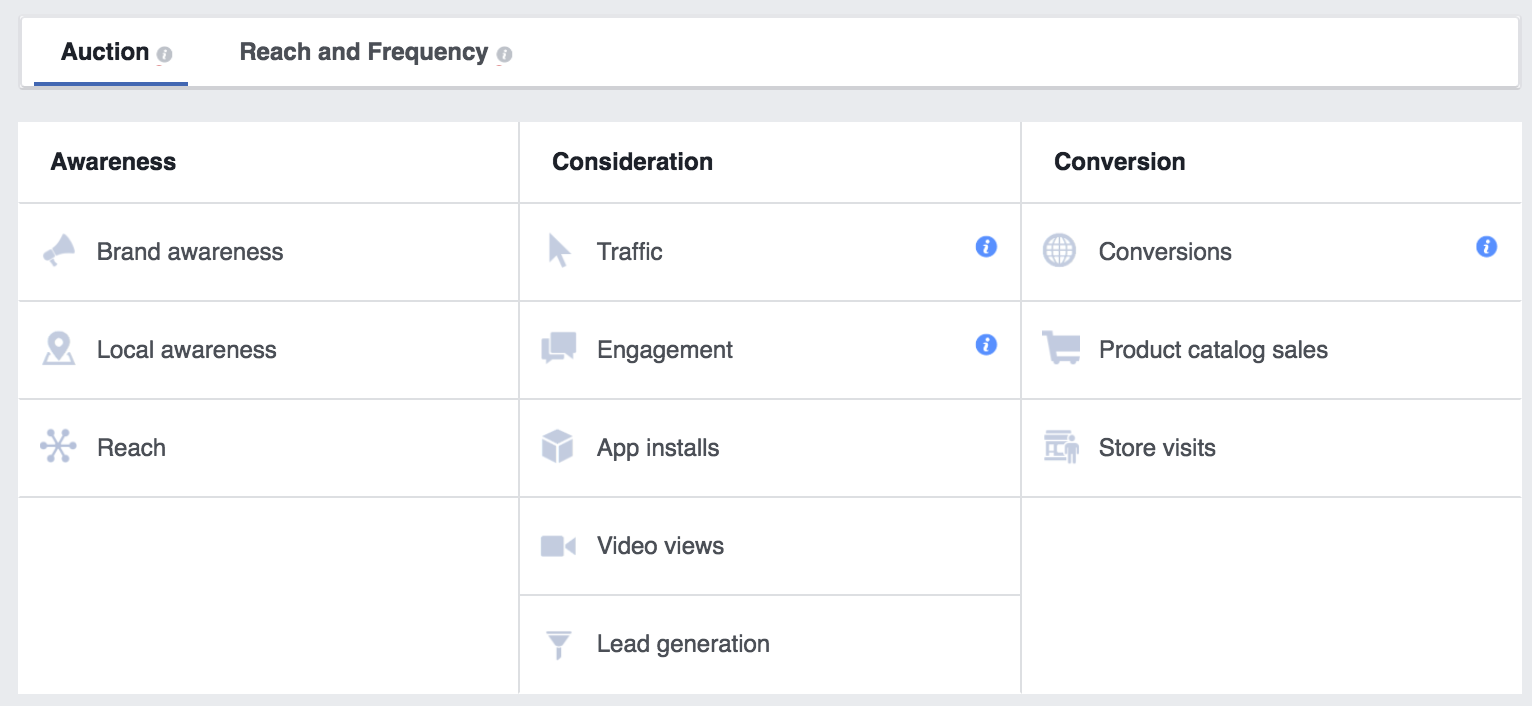
Image source: https://www.facebook.com/business/help/132037906870538
3. Decide who you want to see your ad based on age, location, and other identifiers.
4. Pick where to place your ad, in case you want it to show up outside of Facebook or on specific devices.
5. Set a budget for your Facebook ad, choosing either daily or lifetime limits.
6. Choose a Facebook ad format that suits your objective. Though Facebook adjusts these every now and then, your current options are:
- Photo
- Video
- Carousel
- Slideshow
- Collection
7. Start your campaign!
Modern Advertising Features
Facebook ads (now managed through Meta Ads Manager) allow businesses to create campaigns from scratch with more advanced targeting, placements, and campaign objectives.
Unlike boosted posts, ads allow businesses to optimize for specific goals, such as:
- Lead generation
- Website conversions
- Online purchases
- Appointment bookings
- App downloads
Ads Manager also gives businesses access to advanced audience targeting, including:
- Custom audiences based on website visitors or email lists
- Lookalike audiences that mirror existing customers
- Retargeting campaigns for people who interacted with previous ads
These advanced targeting tools help businesses show ads to people who are more likely to take action, not just engage with a post.
Advantage+ Campaign Automation
Meta has introduced Advantage+ advertising, which uses automation and AI to help optimize campaigns automatically.
With Advantage+ features, Meta can:
- Automatically test multiple audience segments
- Optimize placements across Facebook and Instagram
- Adjust budgets based on performance
- Generate variations of ad copy and creative
These tools help small businesses launch campaigns faster while still benefiting from the platform’s data and machine learning.
AI-Generated Ad Creative
Meta now offers AI-assisted creative tools that automatically generate multiple ad variations based on existing copy and images.
These systems can test different ad text, images, and calls-to-action to improve performance. In large-scale testing, AI-generated ad variations have shown measurable improvements in click-through rates compared with single static ads.
For small businesses with limited time or marketing resources, these AI tools can help create and test ads more efficiently.
Boosted Post Ads
These are the trickiest of the bunch, as they blend the benefits and the drawbacks from the previous ad types. The best time to use these is if you typically use your Facebook page as an educational, engagement platform. Using a boosted post ad, you can keep your more targeted promotional messaging from appearing on your Business Page.
Key Differences Between Facebook Ads and Boosted Posts
| Feature | Boosted Posts | Facebook Ads |
|---|---|---|
| Setup | Boost an existing post | Create ads in Ads Manager |
| Main goal | Engagement and visibility | Leads, traffic, conversions |
| Targeting | Basic demographics & interests | Custom audiences, retargeting, lookalikes |
| Ad formats | Same as the original post | Video, carousel, reels, catalog ads |
| Placements | Mostly automated | Full control across Meta platforms |
| Optimization | Limited | Advanced campaign optimization |
Boosted posts are designed to increase reach and engagement, while Facebook ads are designed to drive measurable business outcomes like leads or sales.
Modern Facebook Ad Tactics for Small Businesses
1. Promote High-Performing Organic Posts
If a post is already getting strong engagement, boosting it can extend its reach to a broader audience. This strategy allows businesses to capitalize on content that is already resonating.
2. Use Ads Manager for Lead Generation
Businesses that want measurable results, such as bookings, form submissions, or purchases, should create campaigns in Ads Manager instead of relying on boosted posts.
Ads Manager allows optimization for specific outcomes like conversions or lead forms.
3. Run Retargeting Campaigns
One of the most powerful Facebook advertising strategies is retargeting.
You can show ads to people who:
- Visited your website
- Engaged with your social media posts
- Watched your videos
- Messaged your business
These audiences are already familiar with your business, which often leads to higher conversion rates.
4. Test Multiple Creative Formats
Modern Facebook campaigns perform best when businesses test multiple creative formats, such as:
- Short-form video
- Reels ads
- Carousel product ads
- Image ads with strong calls-to-action
Testing different creative formats allows the algorithm to determine which ads generate the best results.
Don’t Get Stuck
Both boosted posts and Facebook ads play an important role in a modern social media marketing strategy.
Boosted posts are ideal for increasing visibility and engagement quickly, especially when you want to promote content that is already performing well.
Facebook ads created in Ads Manager offer more control, targeting, and optimization, making them better suited for businesses that want to generate leads, sales, or measurable marketing results.
For many small businesses, the best strategy is to use both together — boosting high-performing content while running targeted ad campaigns that drive real business outcomes.
Editors Note: This post is frequently updated for accuracy. Updated 3/16/26.