
Online reputation is no longer just about responding to the occasional review. As we move into 2026, search visibility, customer trust, and buying decisions are increasingly shaped by how consistently and strategically businesses manage reviews, ratings, and brand mentions across the web.
For small business owners, investing in online reputation management software is only the first step. Real ROI comes from setting it up correctly, using it consistently, and optimizing it over time. This comprehensive checklist is designed to help you do exactly that. Whether you’re implementing reputation tools for the first time or auditing your current setup, this checklist walks through how to generate more reviews, monitor brand mentions, respond effectively, and turn reputation data into growth.
Why Online Reputation Management Software Matters in 2026
Consumers rely on online reviews more than ever. In fact, 93% of consumers say online reviews influence their purchase decisions, making star ratings a key driver of trust and click-through behavior. Review freshness also plays a critical role in visibility and credibility: only 8% of consumers say recency does not affect their decisions, meaning outdated feedback can quietly undermine conversions. And how businesses handle feedback matters just as much as the reviews themselves: 85% of consumers consider whether a business responds to negative reviews when deciding where to spend, signaling that every response (or lack of one) directly shapes perception and purchase intent.
Modern small business reputation management tools help companies:
- Centralize reviews and ratings across platforms
- Automate review requests to drive consistency
- Monitor brand mentions beyond review sites
- Respond faster and more effectively
- Protect trust before issues escalate
The following checklist outlines the best practices that differentiate reactive reputation management from proactive, scalable success.
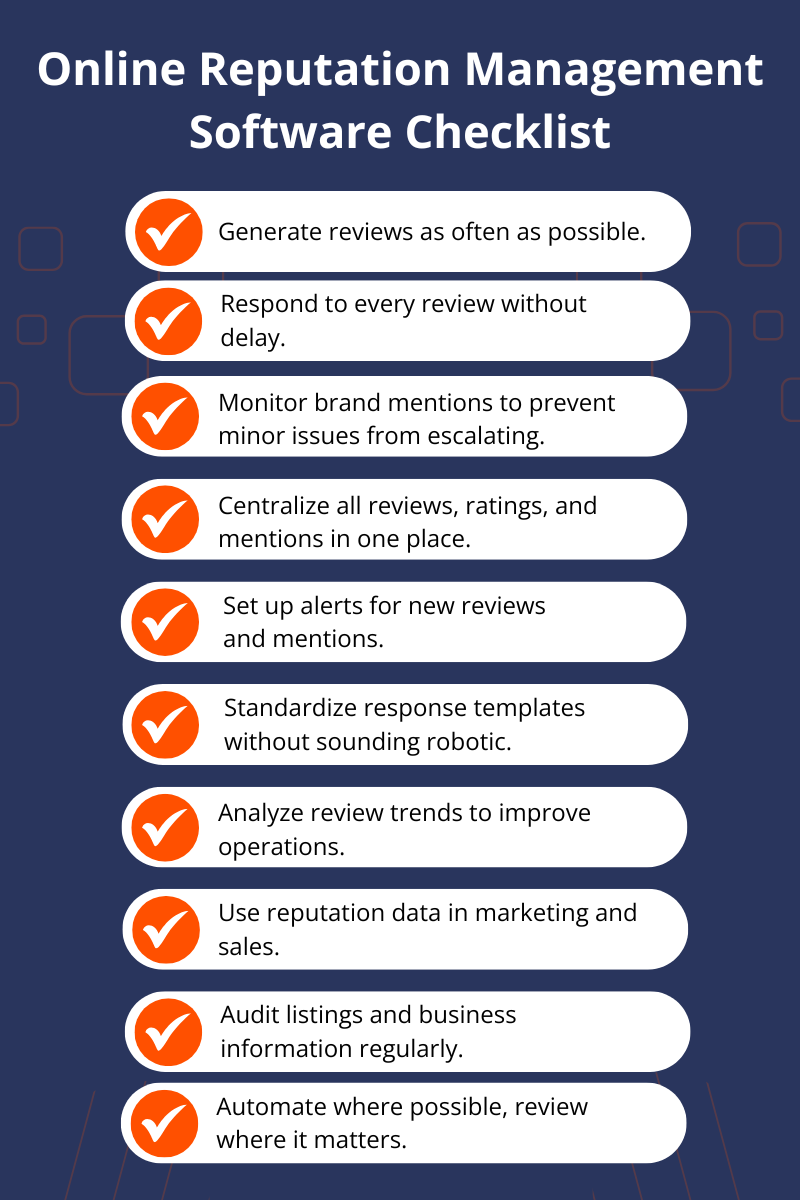
1. Generate reviews as often as possible.
Consistent review generation isn’t optional, but foundational. Search engines prioritize businesses with recent, authentic reviews, and customers trust brands that show ongoing engagement. The goal isn’t a one-time review push, but a repeatable system that runs year-round. The answer to “how to get more reviews” is automated review requests.
Checklist actions:
- Enable automated review requests after purchases, appointments, or completed jobs
- Choose the right timing (immediate follow-up often performs best)
- Focus requests on platforms that matter most for your industry
- Track review volume trends monthly, not just total count
Online reputation management software simplifies this by automating requests, so review generation happens in the background, supporting predictable growth rather than sporadic spikes.
2. Respond to every review without delay.
Responding to reviews isn’t just about damage control. It’s a visibility and trust signal. Customers notice when businesses acknowledge feedback. Search platforms do too. Consistent responses demonstrate accountability, professionalism, and appreciation, even when feedback isn’t perfect.
Checklist actions:
- Create response guidelines for positive, neutral, and negative reviews
- Set internal response-time benchmarks
- Personalize replies using customer details when possible
- Thank customers for positive feedback and address concerns respectfully
Reputation monitoring tools that consolidate reviews into a single dashboard make it easier to respond promptly without logging into multiple platforms. This reduces response gaps and ensures no review goes unnoticed.
3. Monitor brand mentions to prevent minor issues from escalating.
Reviews aren’t the only place your reputation lives. Brand mentions can appear on social platforms, local forums, blogs, and business listings, often before formal reviews appear. Monitoring these mentions allows businesses to spot issues early and respond before they escalate publicly.
Checklist actions:
- Track brand name, business variations, and key service terms
- Monitor mentions across review sites, social media, and listings
- Flag recurring complaints or themes
- Address misinformation quickly
Brand monitoring tools provide early-warning visibility, enabling businesses to engage proactively rather than react defensively.
4. Centralize all reviews, ratings, and mentions in one place.
Fragmented reputation management creates blind spots. When reviews and mentions live across disconnected platforms, it’s easy to miss feedback or duplicate effort. Centralization improves speed, accuracy, and consistency.
Checklist actions:
- Use software that aggregates reviews from major platforms
- View ratings, mentions, and responses in one dashboard
- Assign ownership for monitoring and response tasks
- Maintain consistent messaging across channels
Some platforms, including Thryv, offer dashboards that consolidate reviews, ratings, and mentions, reducing complexity and improving day-to-day visibility.
5. Set up alerts for new reviews and mentions.
Speed matters in reputation management. The faster you respond, the more control you retain over perception. Alerts ensure you’re notified the moment new feedback appears.
Checklist actions:
- Enable real-time notifications for new reviews
- Set alerts for brand mentions and keyword triggers
- Create escalation rules for urgent issues
- Avoid notification overload by prioritizing platforms
Timely alerts prevent negative feedback from sitting unanswered and allow businesses to capitalize quickly on positive momentum.
6. Standardize response templates without sounding robotic.
Consistency is essential, but authenticity matters just as much. Templates help teams respond faster, but they should always allow room for personalization. Customers can spot generic responses instantly.
Checklist actions:
- Create response templates by review type
- Personalize with names, services, or locations
- Keep tone professional and human
- Update templates annually to stay current
Well-designed workflows balance efficiency with sincerity, making responses feel thoughtful rather than automated.
7. Analyze review trends to improve operations.
Your reviews are more than feedback; they’re business intelligence. Reputation management software provides insight into what customers love, where friction exists, and which improvements will have the most significant impact.
Checklist actions:
- Track common keywords and recurring issues
- Identify top-performing services based on feedback
- Share insights with operations and customer service teams
- Use review trends to guide training and process changes
When feedback loops inform internal decisions, reputation management becomes a growth driver, not just a marketing task.
8. Use reputation data in marketing and sales.
Positive reviews shouldn’t live only on review sites. They’re powerful social proof that can be repurposed across marketing channels to reinforce credibility and influence decisions.
Checklist actions:
- Feature recent reviews on your website
- Share customer feedback on social media
- Use testimonials in email campaigns
- Highlight ratings in ads and listings
Integrated reputation tools make it easier to pull approved reviews into campaigns without manual copying or compliance risks.
9. Audit listings and business information regularly.
Incorrect business information damages trust and rankings. Reputation management includes ensuring your local listings reflect accurate hours, services, and contact details, especially as platforms update frequently.
Checklist actions:
- Review listings quarterly
- Confirm hours, addresses, and phone numbers
- Update seasonal changes promptly
- Monitor duplicate or outdated listings
Accurate listings support both reputation and discoverability.

10. Automate where possible, review where it matters.
Automation improves consistency, but oversight ensures quality. The most effective reputation strategies combine automation for repetitive tasks with human review for nuanced situations.
Checklist actions:
- Automate review requests and alerts
- Review responses before publishing when needed
- Audit workflows annually
- Adjust rules as platforms and customer behavior evolve
Tools that support automated review requests, such as those in Thryv, help sustain steady review growth while freeing up time for higher-impact work.
Turning Reputation Management into Long-Term ROI
Online reputation management software delivers the highest ROI when it’s treated as a system, not a task. By following this 2026 checklist, small businesses can:
- Generate more reviews consistently
- Build trust through timely engagement
- Monitor brand perception proactively
- Turn feedback into operational and marketing insights
Reputation isn’t static. It’s an ongoing conversation, and the businesses that manage it intentionally are the ones that win attention, trust, and loyalty over time.