
Key Takeaways
- Local SEO helps your business appear when nearby customers are ready to hire a contractor or local company.
- Reviews influence both your search rankings and whether customers choose your business.
- Accurate business listings improve visibility across Google, maps, and AI search tools.
- A fast, mobile-friendly website helps turn searches into calls and quote requests.
- SEO results for your small business build over time, but early signs can show whether your visibility is improving.
- Consistency across listings, reviews, content, and your website helps bring in more leads long term.
SEO for small businesses can be the difference between generating leads precisely when they need you vs. being invisible and never getting the call.
A homeowner searches on Google for an emergency plumber at 9 PM. Multiple businesses show up. One has recent reviews, updated hours, clear service information, and a professional-looking website that loads fast on mobile. The others look outdated or incomplete.
That’s usually the difference between getting the call and losing the job.
SEO helps your small business show up when local customers are actively searching for the services you offer. For plumbers, HVAC companies, electricians, roofers, and other local service businesses, that visibility can turn into more calls, more booked jobs, and more repeat customers over time.
The challenge is that, when it comes to SEO, most small business owners don’t know what to focus on first. Listings, online reviews, websites, blog posts, Google Business Profiles, and AI search results all require management. Falling behind can cost you leads every week.
This small business SEO guide breaks down the practical steps that help local service businesses get found online, build trust faster, and turn searches into paying customers using services like Thryv® to keep everything moving consistently.
Try the New Thryv Experience
See what’s new — and why it gives your business an edge.

Why SEO Matters More Than Ever for Local Service Businesses
When someone’s basement floods or their AC stops working in the middle of July, they usually don’t spend hours researching companies. They search, scan a few results, and call one of the businesses they trust first.
A customer searching for “water heater repair near me” will often contact one of the first businesses with strong reviews, up-to-date information, and a website that loads quickly on mobile devices. If your hours are outdated or your reviews are old, that lead can disappear before you even know they were searching.
Strong local SEO also helps reduce your reliance on Google Ads for every lead. A well-optimized local presence can continue bringing in calls months after a service page or customer review was first published.
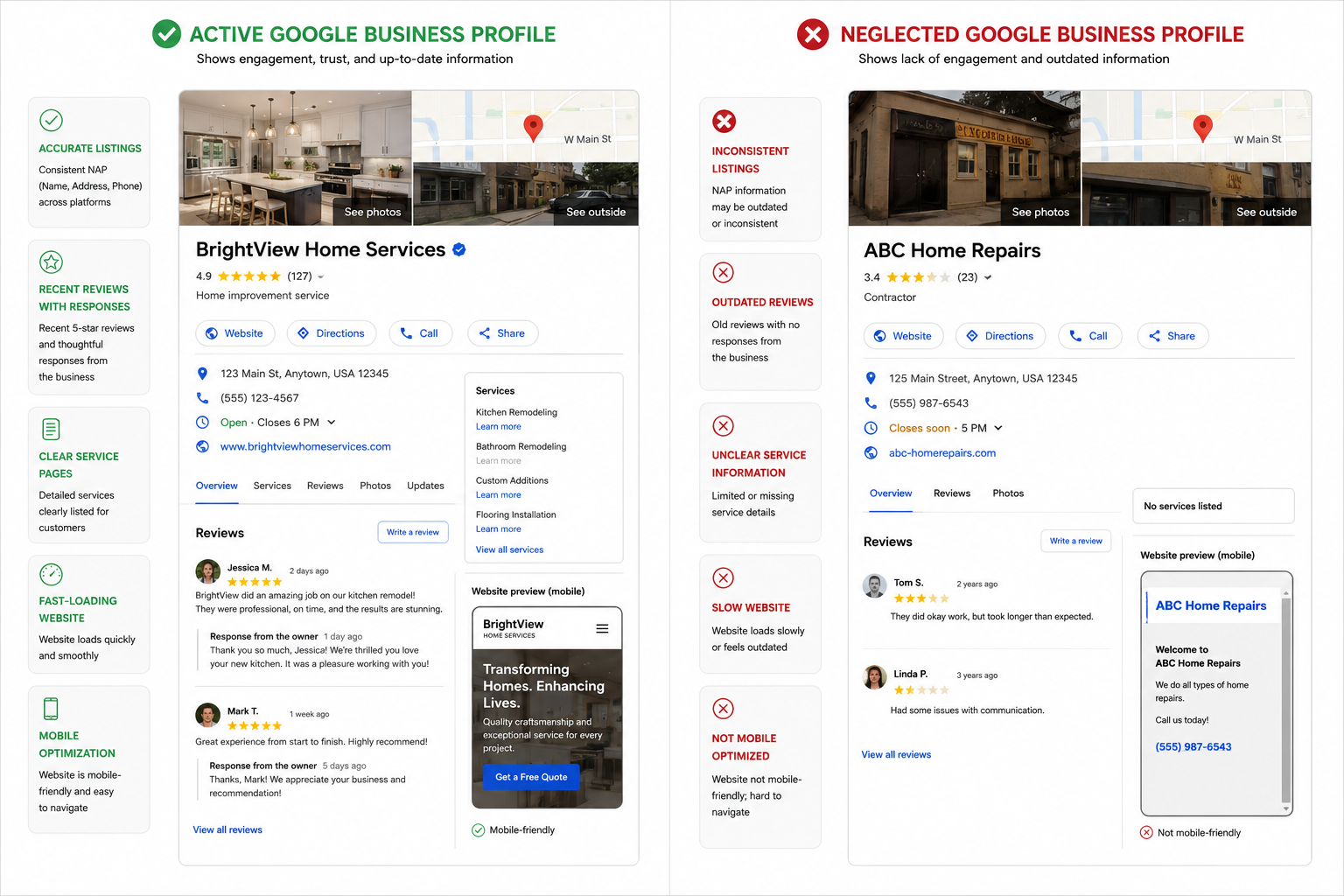
Service businesses showing up consistently in local searches usually have:
- Accurate business listings across multiple platforms
- Recent customer reviews with responses
- Clear service pages
- Fast-loading websites
- Mobile optimization
A roofing company with 75 recent reviews and updated project photos usually earns more trust than a business profile that looks inactive.
If you want more practical ways to improve visibility, these actionable SEO tips for small businesses can help you identify where to start.
Local SEO vs. Traditional SEO: What’s the Difference?
Traditional SEO helps websites appear in broader search results across search engines.
Local SEO focuses on helping nearby customers find your business when they’re ready to hire someone.
For example, an HVAC company in Dallas benefits more from showing up for searches like “AC repair near me” or “emergency HVAC repair Dallas” than from attracting visitors outside its service area.
That’s why local SEO focuses heavily on reviews, Google Maps visibility, business listings, Google Business Profiles, and service-area relevance.
The SEO Actions Every Small Business Should Take First
When managing SEO for a small business, it can feel overwhelming when listings, reviews, websites, AI tools, and Google rankings are all competing for your attention.
Start with the areas customers notice first:
- Your Google Business Profile
- Your reviews
- Your website
- Your content
- Your business information across directories
If your phone isn’t ringing consistently, focus on these fundamentals before worrying about advanced SEO strategies and tactics.
Claim and Complete Your Google Business Profile
When someone searches for a local service business, your Google Business Profile (GBP) is often the first thing they see before they ever visit your website.
If your hours are outdated, your phone number is wrong, or your profile looks incomplete, customers may move on quickly. That’s especially true during urgent searches like “emergency electrician near me” or “same-day AC repair.”
Start by verifying and updating:
Business name, phone number, and service areas
- Service areas and categories
- Hours (including holiday updates)
- Recent job photos and project descriptions
Keeping listings updated across multiple directories can become difficult once your business grows. If your holiday hours change, manually updating every directory can take hours and still leave outdated information online. That’s where business listings management software can help sync updates across platforms automatically and reduce missed calls caused by incorrect information.
Audit Your Business Listings for Consistency
Business listings are an important part of SEO for small businesses. Customers often find businesses through directories, review sites, map apps, and search engines before they land on a website. If your phone number or hours are different across platforms, customers may call someone else instead.
For example, if your Google profile says you close at 6 PM but another listing still says 5 PM, customers searching after work may assume you’re unavailable.
Start with a simple audit:
- Remove duplicate listings
- Update old addresses and service areas
- Confirm phone numbers match everywhere
- Check service areas and business hours
Thryv’s online business presence scan can help identify gaps that may be affecting visibility without forcing you to check every listing manually.
Research Keywords Your Customers Use
Keyword research starts with understanding how customers describe the problem they need solved right now.
A homeowner dealing with a burst pipe usually isn’t searching for broad industry terms. They search for the service they need right now:
- “Emergency plumber open now.”
- “Drain cleaning near me.”
- “AC repair in Phoenix”
Those searches matter because they usually come from customers ready to book work. Use Google Search Console and Google Analytics to see which searches already bring people to your website. Pay attention to search volume and keyword difficulty, but focus first on searches tied directly to calls, quote requests, and booked jobs.
Optimize Your Website for Local Search
A customer landing on your site should immediately understand three things:
- What you do
- Where you work
- How to contact you
If they have to search for a phone number or wonder whether you serve their area, there’s a good chance they’ll leave.
Focus on:
- Mobile optimization and fast site speed
- Clear service pages
- Click-to-call buttons above the fold
- Landing pages for major services and cities
- Structured content that’s easy to scan
An HVAC company serving multiple cities may benefit from separate landing pages for: “AC repair in Scottsdale,” “Furnace installation in Tempe,” and “Emergency HVAC service in Mesa.” Those pages help customers quickly confirm they’re in the right place.
Thryv’s AI-powered website builder for small businesses to keep service pages up to date without relying on a developer whenever a service area, promotion, or seasonal offer changes.
Publish Content That Answers Real Customer Questions
Customers often search for answers before they contact a business.
Questions like:
- “Why is my AC leaking water?”
- “How much does drain cleaning cost?”
- “Signs your electrical panel needs replacement.”
These types of questions can help your business appear in local searches and AI search results. You don’t need to publish long articles every week. Short answers based on real customer questions are often enough to support content creation and keep your website active.
Thryv’s AI Content Assistant helps local service businesses to turn completed jobs into website FAQs, service updates, or social posts.
For example, after a furnace repair, a technician’s notes can quickly become a winter maintenance tip for homeowners, a service page update on warning signs of furnace failure, or a social post reminding customers to schedule inspections before colder weather arrives.
That keeps your website and online presence active without creating extra manual work every week.
Build Local Authority Through Reviews and Links
A customer comparing two plumbers will usually notice reviews first. If one business has recent reviews with active responses and the other hasn’t received feedback in months, trust shifts quickly.
As a key element in SEO for small businesses, reviews influence whether customers call your business and how visible you appear in local searches. After completing a job, make review requests part of your normal follow-up process.
For example, after an AC repair, the customer could receive:
- A review request later that afternoon, when the job is completed
- A follow-up check-in a few weeks later
- A reminder before the next seasonal tune-up
When a positive review comes in, Thryv’s AI Review Response can publish a professional response quickly while the job is still fresh. Active review responses help your business appear active in search results and give future customers more confidence to contact you.

Turn Search Visibility Into More Leads
Thryv’s Search Boost helps improve your online visibility while connecting search performance to real leads, calls, and revenue growth.
Your Google Business Profile Is Doing More Than You Think
A lot of businesses set up their Google Business Profile once and barely touch it again. Meanwhile, competitors keep adding reviews, updating photos, and posting new service updates. Over time, inactive profiles can lose visibility and trust.
A homeowner searching for “emergency electrician near me” may compare several businesses in less than a minute. Profiles with updated photos, clear services, and recent reviews usually stand out first.
Business Description
A strong description does three things: it tells customers exactly what services you offer, confirms you serve their area, and gives them a reason to choose you over a competitor with a similar profile.
Service Categories
One of the easiest improvements is choosing accurate service categories. A plumbing company offering emergency drain cleaning and water heater repair should make sure those services appear clearly throughout the profile, not just “plumber.”
Images
Customers want to see the work you do. Update your profile regularly with recent job photos, team photos, service cars, and completed projects. Updated visuals build credibility before a customer ever contacts you.
Review Monitoring and Response
Reviews also influence whether customers contact you or move to another business. Keeping up with responses manually can become difficult during busy weeks. Tools like Thryv’s AI Review Response can help businesses respond faster without spending extra time writing every reply individually.
Google Posts and Q&A
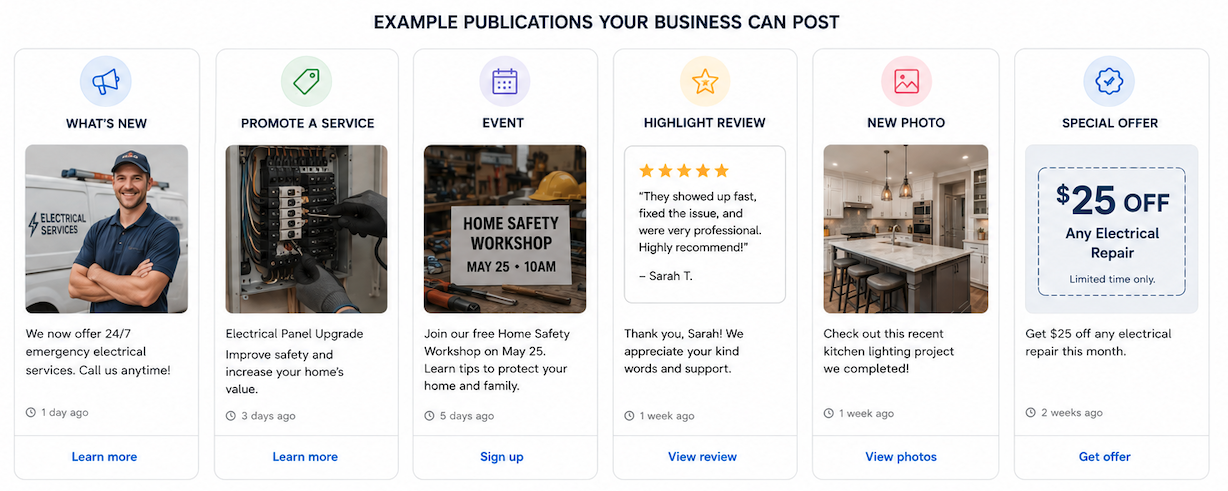
Google Posts and Q&A sections also help keep profiles active. Posting seasonal reminders, financing offers, or weather-related service updates gives customers more reasons to engage with your business and helps support visibility in AI overviews and local searches.For a deeper walkthrough, the Ultimate Google Business Profile Guide covers additional ways to improve visibility and customer engagement.
SEO in the Age of AI: AEO, GEO, and What’s Changing
Customers still use Google every day, but many searches now include AI search results, AI overviews, and local business recommendations directly inside the results page. Tools like Google AI Overviews, Google AI Mode, Google Gemini, ChatGPT, Perplexity, and voice assistants are reshaping how people find local service businesses.
For service businesses, the takeaway is simple: AI search tools still rely on the same information customers use before contacting a business.
That includes:
- Reviews
- Accurate listings
- Clear service pages
- Helpful answers to customer questions
- Updated Google Business Profiles
If your business information is inconsistent across platforms, visibility can suffer across both traditional search results and newer AI search tools.
| Term | What It Is | When to Use | Example (What It Looks Like) |
| AEO | Answer Engine Optimization focuses on helping your business appear in direct answers and AI summaries. | Helpful when customers ask detailed questions online e.g., service how-tos, cost FAQs, troubleshooting. | “Why is my AC unit freezing up?” |
| GEO | Generative Engine Optimization focuses on improving how AI tools understand and recommend your business | Helpful as AI search tools become more common. | AI recommending a local roofing company with strong reviews and updated listings. |
| SEO | Search Engine Optimization helps your business rank in traditional search results. | Helpful for improving visibility in Google and map searches. | Showing up in the top results when someone searches for “plumber near me” on Google. |
Businesses that maintain a consistent, complete online presence are better positioned to appear in all three types of search.
Local businesses trying to manage listings, reviews, website optimization, and content creation more efficiently often find that small business SEO services help to keep visibility active without requiring the business to handle every update manually. This saves them time. It also means a local SEO expert is leading the way with updates, better ensuring that the SEO work delivers results for your business.
Turn Online Searches Into New Business
Thryv brings the tools, guidance, and services you need into one place. Talk with us to see how SEO can become a consistent growth channel for your business.
How to Know If Your SEO Is Actually Working
It takes time to see SEO results, which can make it frustrating when you’re updating listings, asking for reviews, and improving your website without seeing booked jobs right away. A plumbing company might clean up its Google Business Profile, improve site speed, publish new service pages, and complete a quick content audit this month, but stronger rankings and steady lead flow usually build over time.
There are still early signs that show whether your small business SEO efforts are improving visibility before revenue fully catches up.
Signs Your SEO Is Gaining Traction
Early progress usually shows up through increased visibility and customer activity.
You may notice:
- More Google Business Profile views
- More direction requests through Google Maps
- More website visits from local searches
- More calls coming from Google listings
- New reviews are coming in more consistently
An HVAC company may start seeing more calls for “AC repair near me” after improving reviews, updating landing pages, strengthening internal linking between service pages, and fixing mobile optimization issues on its website.
Google Analytics and Google Search Console can help track website visits and search visibility, but for local businesses, the numbers that matter most are calls, quote requests, direction requests, and form submissions. Those actions connect more directly to improvements in revenue and conversion rates than to traffic alone.
Signs That Something Needs Attention
If customers are finding your business but still aren’t contacting you at the same rate, the issue may not be rankings.
That can happen when:
- Your profile appears in searches, but few people click
- Reviews have slowed down
- Website visits increase without more quote requests
- Competitors have fresher reviews or more updated photos
In many cases, customers compare your business to another company that appears more active online.
That is usually a sign to revisit:
- Review quality
- Website clarity
- Service descriptions
- Photos
- Business hours
- Site speed
- Mobile optimization
A customer searching late at night for emergency service wants quick answers. If your website loads slowly or your contact information is difficult to find, that lead can disappear quickly.
Signs That Something Is Actually Wrong
Some issues can directly hurt visibility and should be fixed quickly:
- Your business is no longer appearing in local searches
- Large ranking drops across search engines
- A suspended or unverified Google Business Profile
- Inconsistent business listings across directories
- Negative reviews are going unanswered
- Incorrect business hours or phone numbers online
If visibility suddenly drops, check your listings, reviews, and Google Business Profile first before assuming something more technical is happening.
What Normal Progress Actually Feels Like
SEO improvements usually happen in stages.
The first 30–60 days often bring:
- More profile views
- More website traffic
- More local search appearances
Around 60–90 days, businesses may start seeing:
- More reviews
- More calls
- More quote requests
- More repeat searches for the business name
Larger revenue improvements often build over 3–6 months as reviews, service pages, internal linking, and listings continue to improve together.For a more detailed look at what local SEO progress looks like, this guide on how to know if your local SEO is working walks through additional signs to watch for.
Here’s What Getting Found Online Actually Looks Like
K&L Roofing increased lead volume by 146% and nearly doubled daily appointments after improving several parts of its online presence over time.
The company focused on building its review profile, improving local search visibility, keeping its website current, and staying consistent with customer follow-up.
Those updates helped the business appear more active online, which translated into more calls and booked work.
As more jobs come in, keeping listings, reviews, and customer follow-up up to date manually can become difficult during busy seasons:
- A completed roofing project can trigger a review request automatically
- New customer reviews can receive AI-generated responses quickly
- Updated service promotions can be published across listings and social pages without updating every platform individually
The result is a combination of consistent reviews, accurate listings, an active website, and automated follow-up, all working together. Read the full K&L Roofing case study to see how stronger local visibility translated into measurable business growth.
146% Increase in Leads
K&L Roofing increased lead volume by 146% and nearly doubled daily appointments, using the same local SEO foundation this guide walks you through.
You’ve Got the Roadmap. Now Put It to Work
Customers are already searching for the services you offer every day. The businesses getting the calls are usually the ones that are easiest to find, easiest to trust, and easiest to contact.
Every outdated listing, unanswered review, or incomplete profile creates another opportunity for a competitor to win the job first. The businesses that stay visible online usually keep the basics updated consistently over time. Their listings stay up to date, their reviews keep growing, and their websites reflect the services they offer today.
That consistency becomes harder to manage once jobs, calls, scheduling, and customer follow-up all compete for attention during the day. That’s where automation helps businesses keep customer follow-up and online visibility moving during busy weeks.
A completed job can trigger a review request automatically, updated holiday hours can sync across listings, and Thryv’s AI Content Assistant can turn technician notes into website updates or seasonal service reminders. AI Review Response also helps businesses publish responses quickly, so profiles stay active without adding more manual work.
Those small updates help local businesses stay visible online, build trust faster, and generate more calls over time.
SEO for small businesses doesn’t have to be complicated. It just has to be consistent. And with the right platform, consistency becomes automatic.
FAQs About SEO for Small Businesses
A: SEO can be one of the most cost-effective ways to generate long-term leads because it helps customers find your business when they’re already searching for your services. With small business SEO, you’re able to guide them to your website at the precise moment when they would be most receptive to learning about your business.
Unlike paid ads, strong local search visibility can continue bringing in calls and quote requests over time. In this way, it’s highly cost-effective for a small business. For local service businesses, even a few additional jobs per month from local search can create a meaningful return.
A: Some companies notice early improvements within the first 30–60 days, especially after updating listings, reviews, and Google Business Profiles. Larger improvements like more booked jobs and stronger rankings often build over 3–6 months. Results depend on your market, competition, review activity, and how consistently your online presence stays updated.
A: SEO helps businesses appear in search results broadly, while local SEO focuses on helping nearby customers find businesses in their area. A national company may want visibility across multiple states, but a local HVAC company benefits more from appearing in searches like “AC repair near me” or “furnace repair in Dallas.” Local SEO relies heavily on reviews, listings, maps, and service-area relevance.
A: Traditional SEO for a small business helps the business to appear in traditional search results when someone types a query in Google. This is the list of links that you see in the Google search engine results page.
Google AI Overviews are content summaries synthesized from multiple sources and generated via AI. They sit atop the traditional Google search results and include both a written summary as well as links to additional sources. AI SEO (also called AEO or GEO) helps a business to appear in not only Google AI Overviews, but also AI answer engines such as ChatGPT, Gemini, Claude, and Perplexity.
Traditional SEO typically involves optimizing a website for target keywords that are relevant to the business. AI SEO, in contrast, directly answers your audience’s questions, typically written in longer, conversational language, often mirroring the way that someone speaks.
For example, someone may type “best plumbers near me” in Google, whereas in ChatGPT they’d write something like, “what are the best plumbers in Chicago with many 5-star ratings and who have been in business for at least 10 years” or “what are the best affordable plumbers in Chicago who specialize in pre-1940s houses?”
A: Yes. While AI search is the future, traditional search (Google) is still the backbone of discovery today, accounting for 80.76% of online searches (Source: Semrush). Check your own website analytics, and you’ll likely see that organic search still represents a significant amount of your website traffic. Marketers should take an integrated approach, focusing on both traditional SEO as well as AI search.
AI search platforms such as ChatGPT, Claude, Gemini, and Perplexity still rely on many of the same signals prospective customers use before contacting a business. Positive reviews, accurate listings, a clear website, an informative blog, helpful answers, and active profiles all help businesses appear in Google search results just as they support stronger AI search visibility. Companies with outdated information or inconsistent profiles may become harder to find as AI tools pull business information from multiple sources online.
A: SEO for small businesses (including local service businesses) involves a number of important steps in order to achieve Google rankings, Google local pack inclusion, organic traffic, and leads. For example, positive customer reviews, accurate online listings, an optimized Google Business Profile, a clear, well-structured website, a dedicated web page per service area, a fast-loading website, an informative blog with FAQs, and on-page optimization all help you to drive greater SEO results. A more advanced step would be to secure backlinks from local businesses, partners, and business associations (local chamber of commerce, etc.). You can even contribute helpful articles to a local publication or industry website or sponsor a local event or sports team (in exchange for a backlink).
A: Many local service businesses already know what they should be doing for SEO to gain greater visibility and leads. The challenge is keeping listings updated, reviews active, and websites current, while still running day-to-day operations.
Whereas other solutions leave all the work to you (even though your schedule is already busy), Thryv helps businesses keep those SEO tasks consistent by doing the SEO activities for you, whether keeping your business information consistent wherever your prospects may find you online, or providing your website with new content, or optimizing pages in your site, etc. Thryv manages the behind-the-scenes work that keeps you ranking.
See What Thryv Can Do for Your Business
Thryv helps small service businesses to show up in local search, build a trusted online reputation, and convert visitors into booked customers, in one unified solution.